
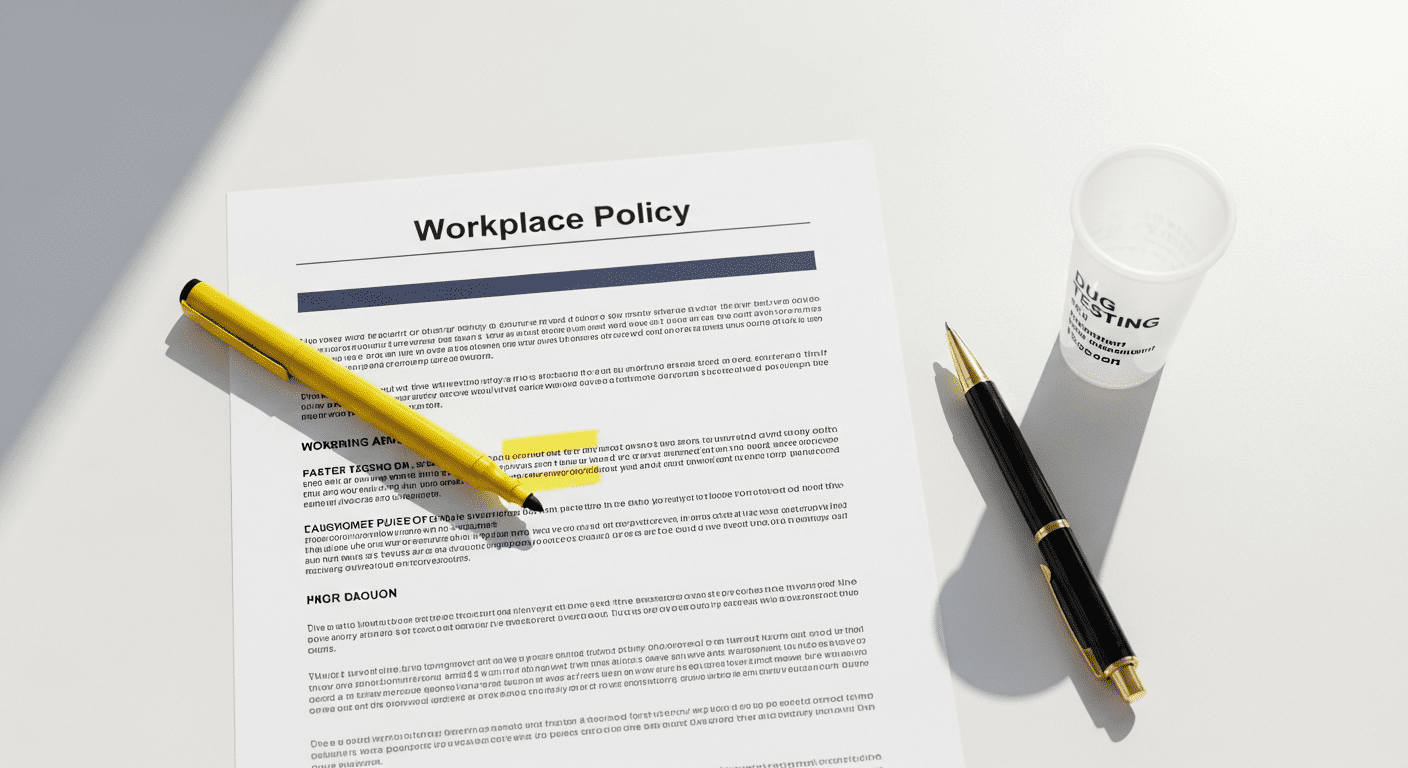
What happens when an employee refuses a drug and alcohol test? If your policy does not answer that question clearly, you may find yourself on the losing end of an unfair dismissal claim — even when the employee’s refusal was deliberate and unambiguous.
A recent Fair Work Commission case proved exactly this point, and it is a wake-up call for every Australian employer with a drug and alcohol testing program.
The Case: Dismissed for Refusal, But the Employer Lost
In a 2025 Fair Work Commission matter, a manager was dismissed after refusing to undergo a drug and alcohol test. The refusal clearly breached the company’s drug and alcohol policy. On the face of it, the employer had a straightforward case.
But the Commission found the dismissal was unfair. Here is why.
The Policy Had No Consequences for Refusal
The company’s drug and alcohol policy was detailed. It covered testing procedures, scenarios, and processes comprehensively. But it contained a critical omission: it did not specify what sanctions would apply if an employee refused to undergo testing.
Without a stated consequence, the employer could not point to the policy as justification for summary dismissal. The Commission found that the employee could not reasonably have known that refusal would result in termination, because the policy did not say so.
The Testing Method Was Not Authorised by the Policy
The employer directed the manager to undergo a blood test. However, this testing method was not expressly permitted by the company’s own drug and alcohol policy. The Commission ruled that a direction to undergo a test not covered by the policy was not a reasonable direction.
This is a crucial point. Even if blood testing is a legitimate method in general, it must be authorised by your specific policy to constitute a lawful and reasonable direction.
The Disciplinary Process Was Flawed
The disciplinary meeting proceeded without providing the employee with written allegations or a clear explanation of which specific policy breaches were being alleged. This lack of procedural fairness further undermined the employer’s position.
The Lessons for Your Policy
1. Explicitly State the Consequences of Refusal
Your drug and alcohol policy should contain a clear statement along the lines of:
Refusal to undergo a drug and alcohol test when directed in accordance with this policy will be treated as serious misconduct and may result in disciplinary action up to and including termination of employment.
Without this, you are relying on a general misconduct framework that may not withstand scrutiny in a tribunal setting.
2. Specify Every Testing Method You May Use
Your policy should list every testing method your organisation may use — oral fluid, urine, breath, blood, or any combination. If a method is not in the policy, do not direct an employee to undergo it.
This also means reviewing your policy whenever you change testing methods or providers. If you switch from urine to oral fluid testing, update the policy first.
3. Cover All Testing Scenarios
A robust policy should address:
- Random testing — how selections are made, how employees are notified
- Post-incident testing — what constitutes a triggering incident
- For-cause testing — what observable signs or behaviours justify a test
- Return-to-duty testing — after a positive result or rehabilitation
- Refusal — what it means and what happens next
4. Ensure Procedural Fairness in Every Disciplinary Action
Even with a perfect policy, the process matters. Before dismissing an employee for a test refusal:
- Provide written notice of the allegations.
- Give the employee an opportunity to respond, including with a support person.
- Genuinely consider their response before making a decision.
- Document every step.
Auditing Your Current Policy
Use this checklist to assess whether your drug and alcohol policy is fit for purpose:
- Does it explicitly state that refusal to test is a disciplinary matter?
- Does it specify the consequences of refusal, up to and including termination?
- Does it list every testing method your organisation may use?
- Does it reference the applicable Australian Standards (AS/NZS 4308 for urine, AS 4760 for oral fluid)?
- Does it cover random, post-incident, for-cause, and return-to-duty testing?
- Has every employee received a copy and signed an acknowledgement?
- Has it been reviewed in the last 12 months?
If you answered "no" to any of these, your policy has a gap that could be exploited in a tribunal.
The Bottom Line
A drug and alcohol policy is only as strong as its weakest clause. Omitting consequences for refusal — or directing employees to undergo testing methods not covered by the policy — creates legal exposure that can turn a clear-cut case of misconduct into an unfair dismissal finding.
Review your policy today. Make sure it says what you mean, covers what you do, and will hold up when it matters most.